

No products in the cart.
Types of Cranes: A Complete Guide to Industrial Cranes
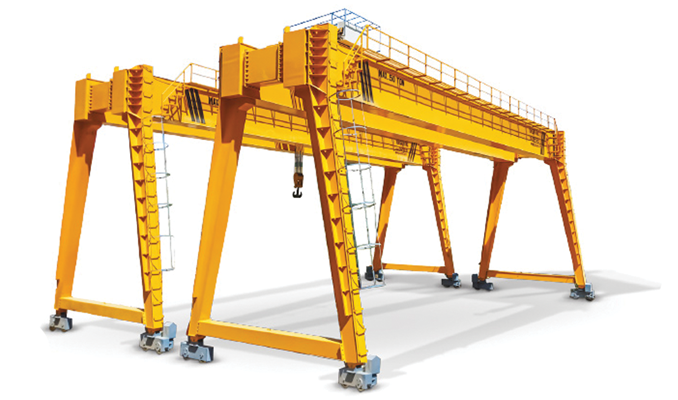
Cranes are essential material-handling equipment used in manufacturing plants, warehouses, construction sites, steel mills, workshops, ports, and many other industrial environments. The right crane can significantly improve lifting efficiency, workplace safety, productivity, and material handling.
There are several types of industrial cranes, and each type is designed for specific lifting capacities, working conditions, and applications. In this guide, we introduce the most common types of cranes and their applications.
1. Overhead Crane
An Overhead Crane is one of the most widely used lifting systems in industrial facilities. It operates on elevated runway rails and allows loads to be moved horizontally and vertically throughout a defined working area.
Overhead cranes are commonly divided into:
- Single Girder Overhead Crane
- Double Girder Overhead Crane
Single Girder Crane
A Single Girder Crane uses one main bridge girder and is generally suitable for light to medium lifting capacities and moderate spans.
It is widely used in:
- Manufacturing facilities
- Workshops
- Warehouses
- Maintenance areas
- Assembly lines
Single girder cranes are often selected because of their simple construction, lower weight, and cost-effective design.
Double Girder Crane
A Double Girder Crane consists of two main bridge girders and is designed for higher lifting capacities and larger spans.
Double girder overhead cranes are commonly used in:
- Steel industries
- Heavy manufacturing
- Power plants
- Foundries
- Shipyards
- Heavy-duty workshops
These cranes provide higher load capacity and can accommodate larger hoisting systems and longer spans.
2. Gantry Crane
A Gantry Crane is a crane supported by legs that run on ground-level rails or another suitable running surface. Unlike overhead cranes, the supporting structure does not necessarily depend on the building structure.
Gantry cranes are commonly used in:
- Outdoor storage yards
- Steel fabrication facilities
- Construction sites
- Shipyards
- Container and material handling areas
Gantry cranes can also be designed as single girder or double girder systems, depending on the required capacity and span.
3. Jib Crane
A Jib Crane is a compact lifting system designed to move loads within a limited working radius. It typically consists of a vertical column or wall-mounted structure with a horizontal jib arm.
Jib cranes are suitable for:
- Production lines
- Machine shops
- Workstations
- Maintenance areas
- Assembly stations
Their relatively compact design makes them an excellent solution when localized lifting and material handling are required.
4. Monorail Crane
A Monorail Crane uses a single fixed rail or beam along which the hoist travels. Unlike a conventional overhead crane, the load generally follows a predetermined path.
Monorail systems are particularly useful in production and assembly lines where materials need to move repeatedly along a specific route.
5. Heavy-Duty Industrial Cranes
Heavy-duty cranes are engineered for demanding applications where high lifting capacity, frequent operation, and severe working conditions are involved.
These cranes are commonly found in:
- Steel mills
- Foundries
- Mining industries
- Power plants
- Shipbuilding facilities
- Heavy manufacturing plants
For these applications, detailed engineering calculations are essential. Important design checks may include girder stress, beam deflection, wheel loads, fatigue, buckling, stability, and crane runway loads.
How to Choose the Right Crane?
Selecting the correct industrial crane requires careful consideration of several engineering parameters, including:
- Lifting capacity
- Crane span
- Lifting height
- Hoist and trolley speed
- Crane travel speed
- Duty class and operating frequency
- Working environment
- Runway and rail conditions
- Building structural limitations
- Required safety standards
Proper crane selection should be based on both the operational requirements and the structural and mechanical design conditions of the project.
Crane Design and Engineering
Professional crane design and engineering involves more than simply selecting a hoist and steel structure. The complete system should be evaluated to ensure adequate strength, stiffness, stability, fatigue resistance, and safe operation.
Engineering calculations may include overhead crane girder design, deflection calculation, wheel load calculation, beam stress analysis, column design, buckling checks, and fatigue analysis.
Conclusion
Choosing the right type of crane is essential for safe and efficient material handling. Overhead cranes, single girder cranes, double girder cranes, gantry cranes, jib cranes, and monorail cranes each provide specific advantages for different industrial applications.
A properly designed crane can improve productivity, reduce material-handling costs, and provide reliable long-term operation. For demanding industrial projects, professional crane design, engineering calculations, and structural analysis are critical to achieving a safe and efficient lifting system.
